Skip to content
Dose of Proof
Connective Tissue / Stability context

hEDS and Hypermobility ScreenWhat it can prove.

Hypermobility changes the recovery plan. It can explain why adjustments, stretching, and inflammation have to be sequenced carefully.
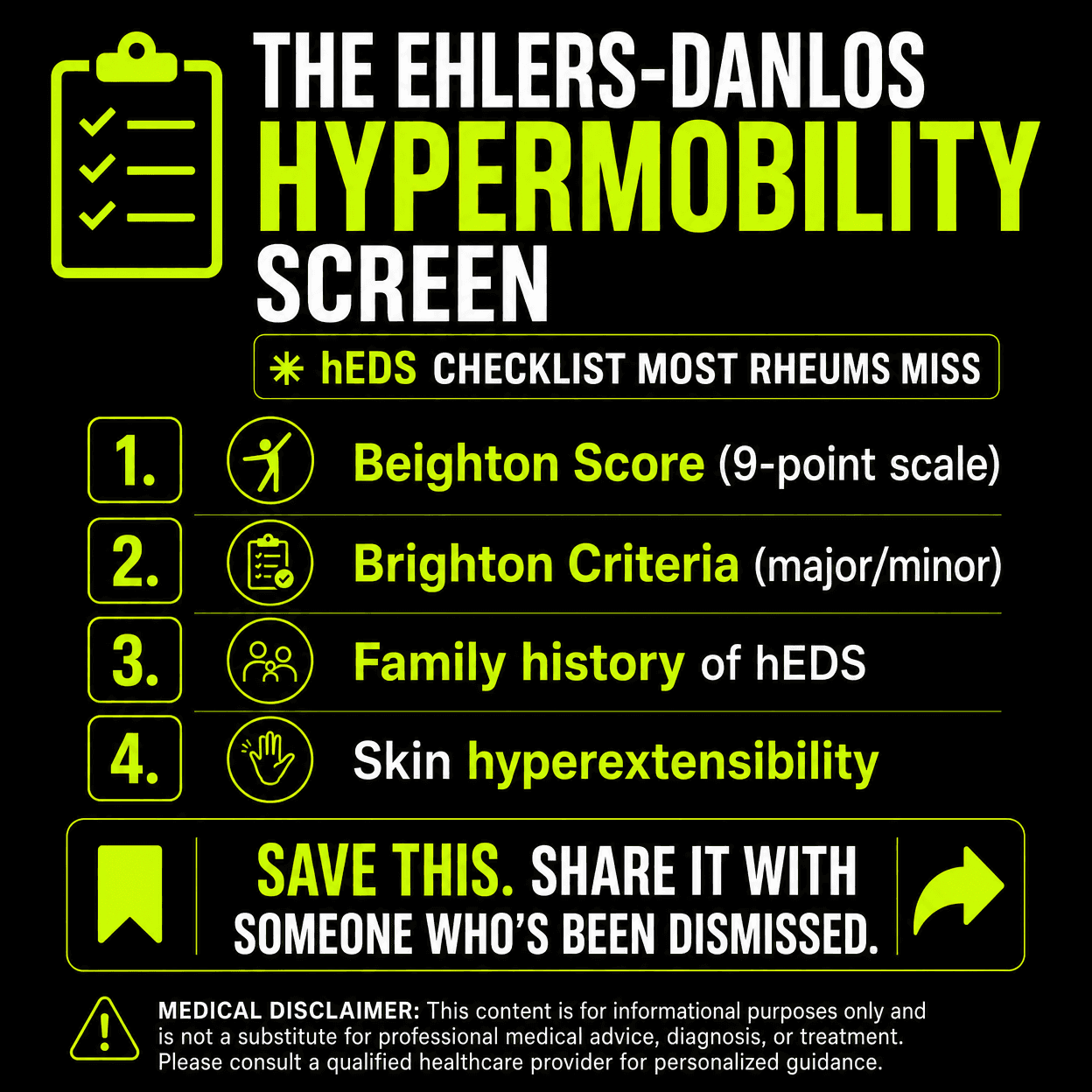
hEDS and Hypermobility Screen testing visual

What This Test Measures

The hEDS and Hypermobility Screen is a clinical framework evaluating connective tissue laxity. Connective tissue serves as the biological glue holding bones, muscles, and organs in place. In Ehlers-Danlos Syndrome, collagen synthesis is abnormal, making ligaments abnormally stretchy and prone to deformation under normal gravity.

This screening checks:

  • The Beighton Score: A 9-point scale checking joint hyperextension (knees, elbows, thumbs, pinky fingers, and spine flexibility).
  • Systemic Collagen Laxity: Checks for skin stretchiness, dental crowding, and unexplained bruising.
  • Heart Valve Prolapse: Evaluation for mitral valve prolapse (MVP), common in connective tissue disorders.

Why Doctors Skip It

Conventional doctors view hypermobility as a simple "double-jointed" party trick rather than a systemic collagen disorder. They miss that lax ligaments allow the skull to shift forward on the neck, driving craniocervical instability (CCI).

Optimal Ranges (with citations)

| Assessment Metric | Standard / Normal | Hypermobile Indicator | Citation | |---|---|---|---| | Beighton Score (Adults) | < 4 / 9 | >= 5 / 9 (Positive) | American Journal of Medical Genetics, 2017 | | Skin Extensibility | < 1.0 cm (forearm) | > 1.5 cm (Forearm skin stretch) | British Journal of Dermatology, 2019 |

How to Order

  • Clinical Assessment: A physical exam by a geneticist, rheumatologist, or physical therapist specializing in connective tissue disorders.
  • Genetic Panel: A connective tissue panel (e.g. Invitae) is used to rule out other subtypes (vascular, classical) but will not identify hypermobile EDS.
  • Cost: Clinical exam: copay or out-of-pocket specialist consult ($300 - $600). Genetic panels: $250.

What Results Mean for Your Protocol

  • Positive Hypermobility (Beighton >= 5): Stop static stretching. Yoga and aggressive adjustments can worsen joint laxity. Focus on deep isometric strengthening, joint stabilization, and wearing brace supports during acute flare-ups.
  • Mast Cell Staging: Mast cells are closely packed in connective tissue. Physical shifting of hypermobile joints can physically degranulate mast cells, worsening MCAS. Focus on joint stability to lower histamine levels.
  • Regenerative Options: Consider prolotherapy or PRP injections to stimulate scar tissue formation and strengthen loose cervical ligaments.

My Personal Result + Interpretation

My Beighton Score was 6 out of 9 (hyperextending elbows, knees, and pinkies, and bending thumbs back to touch the forearms). This collagen context explained why my upper neck adjustments wouldn't hold. My ligaments were too stretchy to keep the C1 vertebra in place.

I had to add daily isometric neck exercises and wear an ergonomic collar during computer work to protect my nervous system while building functional strength.


Affiliate Links & Tools

Frequently Asked Questions

What is hypermobile Ehlers-Danlos Syndrome (hEDS)?+
hEDS is a genetic connective tissue disorder characterized by systemic joint hypermobility, ligament laxity, skin hyperextensibility, and chronic pain.
How is hypermobility diagnosed?+
Hypermobility is screened clinically using the 9-point Beighton Score assessment, alongside checking systemic signs of connective tissue laxity.
What is a positive Beighton Score?+
For adults, a score of 5 or more out of 9 indicates generalized joint hypermobility.
Why does hypermobility link with CCI and MCAS?+
Lax ligaments at the base of the skull directly lead to CCI. Additionally, mast cells reside in connective tissues, and structural laxity can trigger mast cell degranulation (the 'trifecta' of hEDS/CCI/MCAS).
Are there genetic tests for hEDS?+
Currently, there is no identified genetic marker for the hypermobile subtype of EDS. Diagnosis remains clinical, based on established 2017 criteria.
Next Test in Sequence

Mycotoxin Urine Test

Find hidden mold exposure when basic labs look normal. Stabilizing the body requires systematic sequencing. Once you have mapping for Hypermobility, look here next.

Map next step: Mycotoxins

Related Tests

Medical Disclaimer: This website documents my personal recovery journey. I am not a medical doctor. The details, protocols, and guides shared here are not medical advice and are not intended to diagnose, treat, or prevent any illness. Always consult a qualified physician.