Why TyTron Scans Changed Everything for My CCI Diagnosis
In This Article
When standard diagnostics came back normal, I was told my symptoms were just anxiety. But my body was giving me warnings I couldn't ignore.
The turning point in my diagnostic journey wasn't a static MRI—it was a TyTron paraspinal infrared scan.
What Standard Diagnostics Miss
Traditional neurology and orthopedics rely heavily on static, recumbent imaging. You lie flat in an MRI tube, completely still. If the alignment of your skull and upper cervical spine looks roughly correct under zero mechanical stress, you are sent home with a clean bill of health.
But craniocervical instability (CCI) is a dynamic, mechanical problem. The ligaments holding your skull to your spine—specifically the alar and transverse ligaments—are stretched or lax. When you stand up, turn your head, or move through daily life, the bones shift, causing transient compression of vital structures.
Enter the TyTron Scan
A TyTron scan is a non-invasive thermographic device that runs dual sensors down both sides of your spine. It measures heat differentials at micro-levels.
Because your blood vessels are controlled by the autonomic nervous system, localized temperature imbalances correspond directly to autonomic nerve irritation.
When the upper cervical area is unstable, the C1-C2 vertebrae rotate or subluxate, placing mechanical stress on the surrounding nerves—specifically the sympathetic chain and the vagus nerve. The TyTron scan visualizes this irritation as a distinct heat signature "pattern" that remains consistent over multiple scans, proving that the nervous system is under chronic distress.
Irritating the Inflammation Brake
The vagus nerve acts as the body's natural parasympathetic brake. It regulates heart rate variability, digestion, and most importantly, the cholinergic anti-inflammatory pathway.
When C1-C2 instability irritates the vagus nerve:
- The brake is released: Chronic inflammatory cytokines are unchecked.
- Mast cells activate: The body enters a state of persistent hyper-reactivity (MCAS).
- Blood flow drops: Cerebrovascular flow decreases, leading to severe brain fog and burning pain.
The Proof
By documenting my scans over a period of several months, I was able to demonstrate to upper cervical specialists that my alignment was dynamically unstable. Here is the TyTron scan that changed my entire treatment direction:
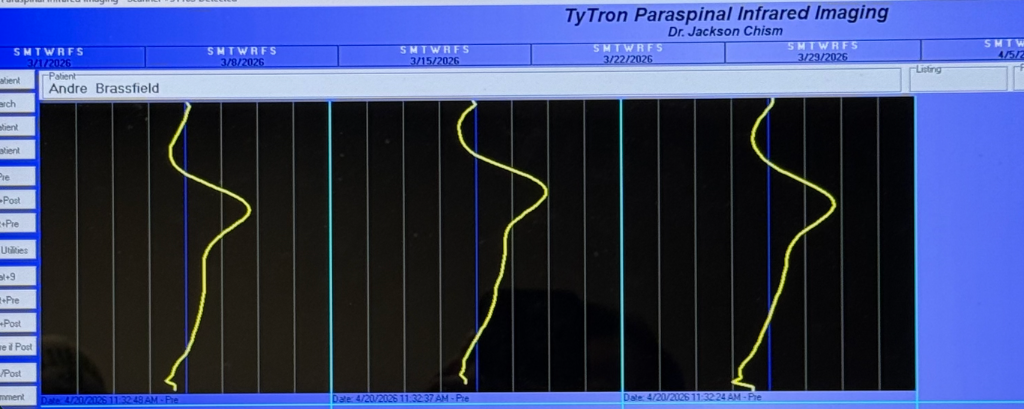
This scan confirmed that the irritation was structural. It wasn't in my head—it was my neck.
Next Steps in Upper Cervical Care
Once the mechanical root cause was verified, my protocol shifted from treating vague symptoms to targeted structural stabilization:
- Upper Cervical Adjustments: Specialized adjustments (such as NUCCA or Blair techniques) to restore symmetry.
- Isometrics and Strength: Building deep cervical flexor strength to stabilize the skull-to-neck junction.
- Vagal Tone Exercises: Supporting autonomic output while the mechanical irritation is reduced.
If you have normal basic labs but abnormal systemic symptoms, stop treating symptoms. Map the mechanical structure first.
Frequently Asked Questions
What is a TyTron scan?+
Why doesn't a standard MRI show C1-C2 instability?+
How does C1-C2 instability affect the vagus nerve?+
Shop the Protocol
Get the exact functional testing guides and protocols I use to maintain remission. For any intervention, work with a licensed telehealth clinician.
Medical Disclaimer
This website documents my personal experience. I am not a doctor. The information shared here is not medical advice and is not intended to diagnose, treat, cure, or prevent any disease. Always consult your physician before starting any new treatment.